Will you change your garments?
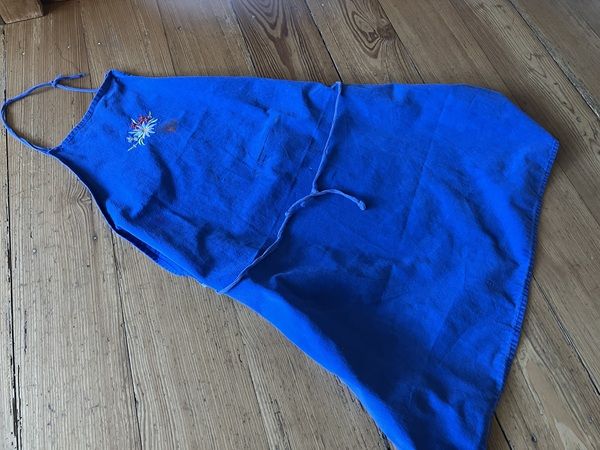
In the Gospel narrative of the foot washing, John reveals an odd little detail. He tells us that after Jesus got up from the table he »took off his outer robe and tied a towel around himself«. In other words, he took the time to make a change of clothes.
This minute detail does not strike us as particularly relevant or interesting, and yet a world of revelation explodes from its kernel. Kings and potentates wear robes. Teachers and preachers wear robes. The robe is a garment of authority, rank and status. It is the garment of privilege and pride of place. Servants, on the other hand, wear aprons. These are garments that designate service to others. It is a garment worn by men and women who do not reign over life, but are constantly in contact with it in its most basic and unadorned form.
When Jesus changes into the garment of a servant, he is revealing the essential pattern that flows from a heart that loves another. We must begin with an essential question. Why is it even necessary for Jesus to take on the role of the servant? The answer is clear. There would, in fact, be no such need if someone else could perform the service required of that moment. However, there are some services that only can be provided by one person. No one else will do. Only one has the skill, the power and the gift to grant that service. If it is the master who can perform the service that is sorely needed, then he has to ask himself a question. Do I love these people enough to change my garments? After all, knowing that he alone can give us the cleansing, healing, rejuvenating touch of life does not force the hand of the Lord. If he did not care for us, he could have shrugged and walked away. Only because he loved us with the most profound and intense of passions did he change his clothes.
In the Gospel of Holy Thursday, Jesus asks the question, “Do you know what I have done to you?” It is a question addressed to his disciples, those who were sitting at table with him in the Jerusalem of Herod’s reign and those who sit with him at table in a world run by the successors of Herod. Do we know what Christ has done for us when he changes clothes to wash our feet? He reveals to us the pattern found in three critical places of our life, namely, the places of 1. communion, 2. saving love, and 3. service. In each of them we must possess the willingness to change our garments for the ones we love.
The Place of Communion
To change our garments is the fundamental pattern of all life-giving communions. Most essentially it is the pattern of the Eucharist. Here, too, Christ changes his garment because he loves us.
Humanity has a hunger and thirst only the Eucharist can fill. Yet, if we are to be served the bread of angels and drink from the cup that brims with life, then we face a dilemma only Christ can solve for us. This is bread only one person can serve, and that is Christ. This is a cup only one person can pour for us, and that is Jesus. Here we stand before the moment when all must hold their breathe and wonder whether Christ, who holds all we need within his hands, will think we are worth a change of garments.
His answer is our joy. In fact, his answer is our life! We eat his body and drink his blood, and therefore we have life in us, because we have Christ in us. This is a body »that is given up for you«. It is given, not seized. In every Eucharist we hear that this blood is »shed for you and for all«. It is the Lord who pours it out freely and gladly. We do not squeeze it from the heart of Christ.
In other words, when the Lord realised that communion with him could not be created without his service, he gave us the Eucharist and told us we are worth a change of garments. The Lord who is clothed in light as in a robe, now clothes himself in bread and wine. All the bread served on the tables of humanity could not satisfy our hungry hearts, so he wrapped himself in bread to still the hungers that growl in our souls. All the wine that has flowed past mortal lips could not slake our deepest thirsts, so he dressed himself in wine in order to pour himself into the depths of our being.
When we see Christ change his garments for us in the Eucharist, we know that we could not have this communion with him in any other way. Thus, we know we have been well loved.
The Place of Saving Love
A change of garments is also necessary at the cross. Here, too, the pattern is revealed, and we realise that it is also the pattern of all saving love.
At Golgatha we come to the moment where we realise that we cannot save ourselves. Salvation is beyond us. We need it and we crave it. We cannot live without it. Yet, we cannot create it, earn it or force it into being. We know full well that we can deny death, but that we cannot definitively defeat it. We can afford expensive tombs, but we cannot roll away the stone from their entrances. If we would live beyond the strictures of mere mortal years, then this gift must come from the hand of another.
Once more we stand at that familiar juncture of the foot washing. Here is a service only the Lord and Master of us all can provide. The question is, will he? Only if our plight moves the heart of the Lord can we hope for a fate greater than eternal death. If he does not love us, then we will not bother to save us, even if he is the only one who can do so.
So, Christ makes the greatest change of garment in the history of salvation. He allows his seamless garment to be torn from him and exchanges it for the loincloth of his crucifixion. In the most vibrant demonstration of love ever witnessed, Jesus showed us all that he was willing to suffer and die for our sake. Yet, that could not have happened if he had not changed his garment. He who is robed in majesty now is clothed in the rags of misery.
Thus, it is revealed to us that you cannot have saving love without a change of garments. When we see the loincloth of the Lord, we know that we are well loved.
The Place of Authentic Service
Finally, the change of garment is revealed in every place of authentic service. For Christ says to us, »So if I, your Lord and Teacher, have washed your feet, you also ought to wash one another’s feet. For I have set out an example, that you should do as I have done to you«. In other words, the pattern of the foot washing is the pattern of all service, and thus the pattern of all Christian life.
There are many moments when we will be asked to change our garments, but where we will only do so if our love for others is greater than our love for all that adorns us. There are services only we can perform, but that does not mean that we will offer them freely and with a glad heart. If we see a folk in need of what we have, and our hearts are glacial in their cold indifference, then we shall walk away, walk past or walk on.
It is no easy task to change our garments, and it will not come lightly to us. It is the Gospel question asked of us at every crossroads where we have what it takes, but are asked whether we can take what we have to give it to another. It is the painful test of discovering whether we will exchange self-sufficiency for loving service. Often, it is shockingly difficult to change our garments with Christ. The magnificent beckons, but the mundane must be served. Excitement lures us, but the everyday commands our presence. We wish to teach a generation whose gaze is filled with wonder, but instead are sent to the owners of eyes that are dull and bloodshot. We want to touch the best of their minds, but are asked to wash the soles of their feet.
When asked to change our garments, we are asked the truest question of love. Not, can you go where you want, but can you go where you are needed? If we can, then many will know that they are well loved.
Erik Riechers SAC
Vallendar, April 2nd, 2026

